


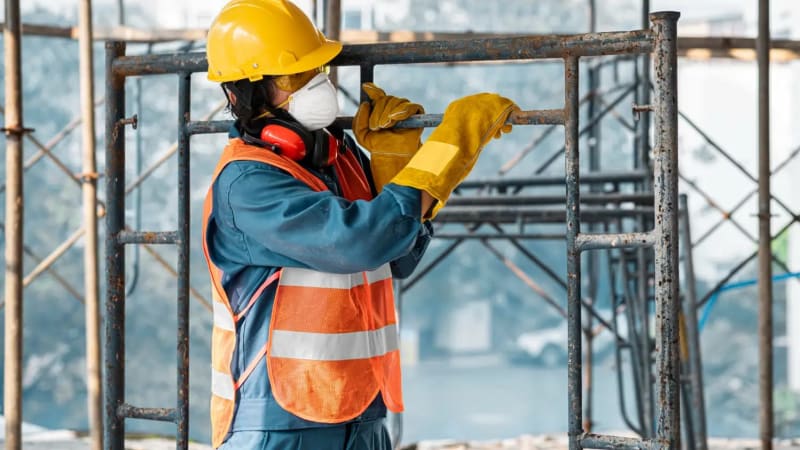
Every year, hundreds of American workers lose their lives because of falls on the job. According to the Bureau of Labor Statistics, 844 workers died from falls, slips, and trips in 2024 alone, with construction accounting for the largest share. Many of these deaths could have been prevented with proper fall protection OSHA requirements in place.
If you are an employer, safety manager, or construction worker trying to understand what OSHA actually requires, this guide breaks it all down. You will learn the height triggers, the types of protection systems, training rules, penalty amounts, and what it takes to stay compliant.
What Are Fall Protection OSHA Requirements?
Why Fall Protection Is OSHA's Most Cited Violation
Here is a number that should get every employer's attention. According to the National Safety Council, fall protection general requirements have topped OSHA's list of most frequently cited violations for 15 straight years. In fiscal year 2025, OSHA issued nearly 5,900 fall protection citations, mostly targeting roofing, framing, and siding contractors.
That means more companies get fined for fall protection failures than for any other safety issue in America. The pattern has not changed in over a decade, which tells us that too many workplaces are still getting this wrong.
Who Must Comply With OSHA Fall Protection Standards?
Every employer whose workers are exposed to fall hazards must comply. This includes construction companies, general industry facilities, warehouses, shipyards, and any workplace where employees work at elevation. OSHA's construction safety regulations fall under 29 CFR 1926, while general industry rules are covered under 29 CFR 1910.
At What Height Does OSHA Require Fall Protection?
This is one of the most common questions people ask, and the answer depends on your industry. OSHA does not have a single height rule that applies everywhere. Instead, the trigger height varies based on the type of work being done.
Fall Protection Height Requirements by Industry
| Industry | Trigger Height |
|---|---|
| General Industry | 4 feet |
| Shipyards | 5 feet |
| Construction | 6 feet |
| Longshoring | 8 feet |
This table is one of the most important references for any safety manager. Knowing your industry's trigger height is the first step toward compliance with OSHA fall protection standards.
When Fall Protection Is Required Regardless of Height
There are situations where fall protection is mandatory no matter how high the walking-working surface is. If workers are above dangerous equipment, machinery, or hazardous materials, OSHA requires protection even at heights below the normal trigger. The same applies to workers near wall openings, floor holes, and leading edges where a fall could cause serious injury.
What Are the 3 Types of Fall Protection Systems?
OSHA recognizes three primary systems for protecting workers from falls. Each has specific design and performance requirements.
- Guardrail systems are fixed barriers installed along open edges. The top rail must be 42 inches high (plus or minus 3 inches) and strong enough to withstand at least 200 pounds of force applied in any direction. Midrails or mesh must fill the gap between the top rail and the walking surface.
- Safety net systems are installed below the work area to catch workers who fall. Mesh openings cannot exceed 36 square inches, and nets must be positioned close enough to the work surface to limit fall distance. They require regular inspection and testing.
- Personal fall arrest systems include a full-body harness connected to an anchorage point through a lanyard or lifeline. These systems must limit the maximum arresting force on a worker's body to 1,800 pounds and stop a fall within a specific distance to prevent contact with lower surfaces.
These are what OSHA calls conventional fall protection. Employers must use one of these three unless they can demonstrate that conventional methods are infeasible for a specific task.
Fall Protection in Construction vs. General Industry
Construction Fall Protection Rules (29 CFR 1926.501)
In construction, fall protection kicks in at 6 feet above a lower level. This covers workers on scaffolds, rooftops, steel structures, and any elevated surface with an unprotected side or edge. The standard is detailed and covers specific situations like leading edge work, hoist areas, ramps, runways, and excavations.
General Industry Fall Protection Rules (29 CFR 1910.28)
General industry has a lower trigger height of just 4 feet. This applies to workers in factories, warehouses, offices, and other non-construction workplaces. The rules cover platforms, loading docks, and any elevated walking-working surface.
Residential Construction Fall Protection Differences
This is an area that catches a lot of contractors off guard. OSHA has separate guidance for residential construction that allows alternative fall protection methods when conventional systems are not practical. For example, during roof sheathing, when plywood is being installed over trusses, using a standard guardrail system may not be feasible. In those cases, OSHA permits a written fall protection plan with alternative measures, but only when a competent person determines that conventional methods truly cannot be used.
Let me share a quick story. A small roofing crew in Texas was cited after an OSHA inspector found workers installing shingles on a residential home without any fall protection at all. The foreman assumed residential work was exempt from the rules. It was not. The company received a serious citation and a fine of over $15,000 for a single violation. Knowing the difference between residential alternatives and a full exemption could have saved them that penalty.
OSHA Fall Protection Training Requirements
What Training Must Employers Provide?
OSHA standard 1926.503 requires employers to train every worker who may be exposed to fall hazards. The training must cover how to recognize fall dangers, how to properly use each type of fall protection system, and the correct procedures for handling, storing, and inspecting equipment.
Who Is a Competent Person Under OSHA?
A competent person is someone who can identify existing and predictable fall hazards in the workplace and has the authority to take immediate action to eliminate them. This is not just a title. OSHA expects this individual to have real knowledge and decision-making power on the jobsite.
How Often Must Fall Protection Training Be Updated?
OSHA requires retraining whenever there is reason to believe a worker does not understand fall protection procedures. This includes situations where workplace conditions change, new equipment is introduced, or a worker demonstrates unsafe behavior. There is no fixed annual schedule, but best practice in the industry is to refresh training at least once a year.
Fall Protection Plans and Rescue Planning
When Is a Written Fall Protection Plan Required?
A written fall protection plan is required only when an employer can demonstrate that conventional fall protection systems (guardrails, nets, or harnesses) are infeasible or create a greater hazard for a specific task. The plan must be site-specific, prepared by a qualified person, and available at the jobsite. It is not a substitute for actual equipment. It is a documented alternative approach for unique situations.
OSHA Rescue Planning Requirements After a Fall
This is a requirement that many employers overlook entirely. OSHA mandates that employers must have a plan for prompt rescue of any worker who falls while wearing a personal fall arrest system. A worker left hanging in a harness can develop suspension trauma within minutes, which can be life-threatening. The rescue plan can involve self-rescue training, on-site rescue teams, or coordination with emergency services, but it must exist before work begins.
OSHA Fall Protection Violations and Penalties
Current Penalty Amounts for 2025 and 2026
According to OSHA's official penalty schedule updated in January 2025, the fines for fall protection violations are significant.
| Violation Type | Maximum Penalty |
|---|---|
| Serious | $16,550 per violation |
| Other-Than-Serious | $16,550 per violation |
| Willful | $165,514 per violation |
| Repeat | $165,514 per violation |
| Failure to Abate | $16,550 per day |
These amounts can add up fast. A single jobsite with multiple fall protection failures can result in penalties well into six figures.
Most Common Fall Protection Citations
The most frequent citations involve missing guardrails on open-sided platforms and rooftops, workers not wearing harnesses when working above 6 feet, lack of floor hole covers, no competent person designated on site, and incomplete or missing fall protection training records.
Real Enforcement Examples
OSHA regularly publishes enforcement cases where companies face major penalties. Roofing and framing contractors are cited most often. A single willful violation, where OSHA determines the employer intentionally ignored the requirement, can result in a fine exceeding $165,000. Repeat offenders face even steeper consequences, including referral for criminal prosecution in cases involving worker fatalities.
Employer Compliance Checklist for Fall Protection
Use this checklist to evaluate your current workplace fall prevention program:
- Conduct a thorough hazard assessment of all elevated work areas
- Install appropriate fall protection systems at all required locations
- Designate a competent person for each jobsite
- Train every exposed worker on fall hazards and equipment use
- Document all training with dates, topics, and attendee signatures
- Inspect all fall protection equipment before each use
- Develop a site-specific rescue plan for fall arrest situations
- Create a written fall protection plan when conventional methods are infeasible
- Keep records of all inspections, maintenance, and incident reports
- Review and update your program whenever conditions or regulations change
FAQ
OSHA requires employers to protect workers from falls using guardrail systems, safety nets, or personal fall arrest systems whenever they work at heights above the industry-specific trigger level.
It depends on the industry. Construction requires fall protection at 6 feet, general industry at 4 feet, shipyards at 5 feet, and longshoring at 8 feet.
OSHA recognizes guardrail systems, safety net systems, and personal fall arrest systems as the three conventional fall protection methods.
Fall prevention stops falls from happening through barriers like guardrails. Fall protection catches or arrests a worker during a fall, like harnesses and safety nets.
Serious violations can cost up to $16,550 each. Willful or repeat violations can reach $165,514 per violation based on the 2025 penalty schedule.
Staying Compliant Starts With Understanding the Rules
Fall protection OSHA requirements are not optional, and the consequences of ignoring them go far beyond fines. Every citation represents a situation where a worker could have been seriously hurt or killed. Whether you manage a large construction site or a small warehouse, understanding these standards, training your team, and keeping your equipment in order is the most effective way to protect both your workers and your business.
Share This Fall Protection Guide
If this guide helped you understand OSHA's fall protection rules, share it with your team or a fellow contractor. Keeping everyone informed is the first step toward a safer jobsite.