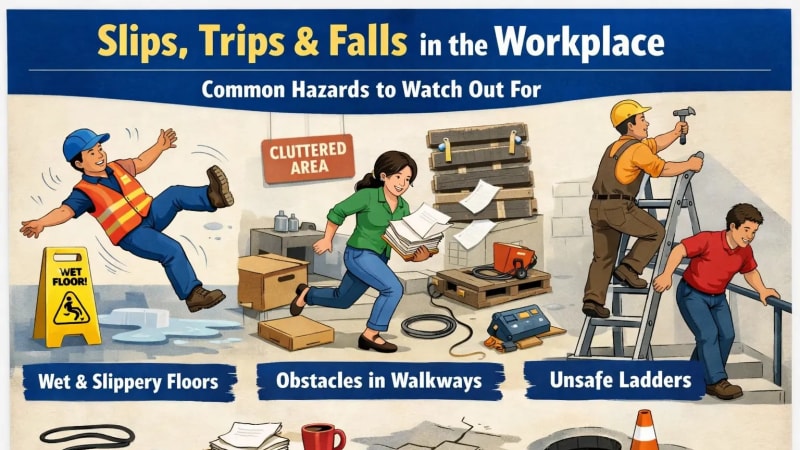

A warehouse supervisor in Texas watched an employee trip over an unmarked cable and catch himself on a shelf rack. Nobody was hurt. The supervisor made a mental note and moved on. Three weeks later, the same cable caused a fractured wrist, a workers' compensation claim, and an OSHA investigation. The near miss had gone unreported, the hazard had gone unfixed, and a preventable injury became an expensive legal problem. Understanding incident reporting procedures in the workplace is how you stop that pattern before it starts. This guide walks you through exactly what the law requires and how to build a system that actually works.
What Is Incident Reporting and Why Does It Matter?
Incident reporting is not just paperwork. It is the feedback loop that keeps workplaces safer over time. Every reported incident, whether it caused an injury or not, is a data point that reveals where hazards exist and where controls have failed.
The Primary Purpose of Workplace Incident Reporting
Reporting serves two purposes simultaneously. The first is legal compliance with OSHA and state safety agencies. The second is continuous safety improvement. When incidents go unreported, the root cause stays in place and the next incident becomes more likely, not less.
What Counts as a Workplace Incident: Accidents, Near Misses, and Hazards
A workplace incident is any unplanned event that results in or could result in injury, illness, property damage, or environmental harm. This includes injuries that required medical treatment, near misses where no one was hurt but easily could have been, property damage caused by a work activity, and exposures to hazardous substances or conditions.
Types of Workplace Incidents That Must Be Reported
Injuries and Illnesses
Any work-related injury or illness that requires medical treatment beyond basic first aid must be documented. This includes cuts requiring stitches, burns, fractures, sprains, and occupational illnesses like hearing loss or chemical exposure conditions. According to the Bureau of Labor Statistics, American private industry employers reported roughly 2.5 million nonfatal workplace injuries and illnesses in the most recent reporting year, representing an incidence rate of 2.3 cases per 100 full-time workers.
Near Misses and Dangerous Occurrences
A near miss is an event that had the potential to cause harm but did not. An electrical arc that startles a worker without injuring them, a forklift that tips but lands safely, a chemical spill that is contained before exposure. Near misses are not minor events. They are warnings the workplace sends before something serious happens, and they must be documented with the same care as actual injuries.
Property Damage, Security, and Environmental Incidents
Vehicle collisions on company property, equipment failures that could endanger workers, security breaches, and accidental chemical releases are all reportable incidents depending on their severity and the applicable standards at your site.
Recordable vs. Reportable Incidents: A Clear Breakdown
This is where many employers make costly mistakes. These two categories are not the same thing, and confusing them leads to both underreporting and overreporting, both of which carry OSHA penalties.
| Category | Definition | Action Required |
|---|---|---|
| Recordable Incident | Work-related injury or illness requiring medical treatment beyond first aid, restricted duty, days away from work, or a professional diagnosis | Log on OSHA Form 300 within 7 calendar days |
| Reportable Incident | Fatality, inpatient hospitalization, amputation, or loss of an eye | Report directly to OSHA by phone or online within 8 to 24 hours |
What Makes a Workplace Injury Recordable Under OSHA
A work-related injury or illness is recordable under OSHA's general industry standard if it results in any of the following: days away from work, restricted work or job transfer, medical treatment beyond first aid, loss of consciousness, or a diagnosis of a significant work-related condition by a licensed healthcare professional.
What Must Be Directly Reported to OSHA and by When
OSHA's mandatory direct reporting deadlines are firm:
- Fatality: Report within 8 hours of learning of the death
- Inpatient hospitalization, amputation, or eye loss: Report within 24 hours
Reports can be made by phone to the nearest OSHA Area Office, through OSHA's 24-hour hotline at 1-800-321-OSHA, or online via OSHA's reporting portal. Late reporting is treated as a separate violation from the underlying incident.
Common Mistakes That Lead to Over- or Underreporting
Overreporting happens when employers record incidents that qualify as first aid only, such as applying a bandage or using a non-prescription medication at a single dose. Underreporting happens when employers fail to record incidents involving restricted duty or hesitate to document injuries out of concern about their recordable rate. Both are violations.
Incident Reporting Procedures in the Workplace: Step-by-Step
This is the core procedural framework every employer needs. Follow these steps in order after any workplace incident.
- Respond immediately and ensure the area is safe. If there is ongoing danger, evacuate and secure the scene before anything else.
- Provide first aid to anyone injured and contact emergency services if injuries are serious.
- Notify the immediate supervisor as soon as the person is safe. Do not wait until the end of the shift.
- Preserve the scene where possible. Do not move equipment, materials, or anything related to the incident before documentation is complete.
- Document the incident with photographs, witness statements, and written notes while details are fresh.
- Complete the required OSHA forms within the required timeframe, specifically Forms 300, 300A, and 301 where applicable.
- Conduct a thorough incident investigation to identify root causes, not just immediate causes.
- Implement corrective actions to eliminate the hazard or reduce the risk, and track completion through closure.
What Must Be Included in a Workplace Incident Report?
A properly completed incident report answers six questions: who was involved, what happened, when it occurred, where it took place, how it happened, and what the immediate contributing factors were.
The Essential Information Every Incident Report Must Capture
- Full name, job title, and department
- Date, time, and exact location
- Factual description of what happened
- Type and nature of injury or hazard
- Names and contacts of all witnesses
- Equipment or substances involved
- Immediate action taken and first aid provided
- Supervisor signature and completion date
The most common error is writing opinions instead of facts. "The employee was careless" is an opinion. "The employee slipped on a wet floor that had no posted warning sign" is a fact. Reports containing opinions create legal exposure and reduce the value of any subsequent investigation.
OSHA Reporting Deadlines and Recordkeeping Requirements (2025)
Most employers with 10 or more employees in industries not classified as low-hazard must maintain OSHA injury and illness logs. The three required forms each serve a distinct purpose:
- Form 300Log of Work-Related Injuries and Illnesses. Updated throughout the year as incidents occur.
- Form 300AAnnual Summary. Posted in the workplace from February 1 to April 30 each year.
- Form 301Injury and Illness Incident Report. Completed for each recordable incident within 7 calendar days.
OSHA requires employers to retain Forms 300, 300A, and 301 for a minimum of five years following the end of the calendar year they cover. During that period, the records must be accessible to current and former employees, their representatives, and OSHA inspectors on request.
Why Near-Miss Reporting Is the Most Underused Safety Tool
Near-miss reporting is where most workplace safety programs leave money and safety on the table. The principle behind it is well established in occupational health research and is sometimes called the safety pyramid or Heinrich's Triangle: for every serious injury in a workplace, there are dozens of minor injuries and hundreds of near misses that preceded it.
Reported near misses are leading indicators. Injuries are lagging indicators. By the time someone gets hurt, the hazard has already existed long enough to cause harm. Near misses reveal the hazard earlier, when corrective action costs far less and no one has been injured yet. The National Safety Council estimates that the average cost of a workplace incident is approximately $40,000 in direct costs alone, with indirect costs running three to ten times higher. A near miss report costs nothing.
How to Encourage Employees to Report Near Misses Without Fear
Anonymous reporting channels, whether a dedicated hotline, a QR code that links to a simple form, or a physical drop box, remove the biggest barrier to near-miss reporting: the fear that reporting something will result in blame. Make it easy, make it anonymous, and make it visible that reports lead to real changes.
What Happens If a Workplace Incident Is Not Reported?
OSHA's current penalty schedule makes underreporting an expensive gamble. Based on updated 2025 figures from OSHA.gov, employers face the following fines:
Failure to report a fatality or severe injury within the required timeframe is treated as a willful violation, meaning the highest penalty tier applies immediately. Beyond OSHA fines, failure to report can expose employers to increased civil liability, workers' compensation disputes, and reputational damage that affects business relationships for years.
Anti-Retaliation Rules and Whistleblower Protections in Incident Reporting
Section 11(c) of the Occupational Safety and Health Act prohibits employers from retaliating against any employee who reports a workplace injury, illness, or safety concern. Prohibited actions include termination, demotion, schedule changes designed as punishment, threats, and any action that discourages future reporting. Violations are investigated by OSHA and can result in reinstatement orders, back pay, and additional damages.
How to Build a No-Blame Reporting Culture That Increases Compliance
A reporting system that employees distrust is not a safety system. It is a liability. These three steps build genuine reporting culture:
- Publicly recognize and thank employees who report near misses or hazards, making reporting a valued behavior visible to the whole team.
- Close the feedback loop by communicating what changed as a result of each report, proving that reports lead to real action.
- Train supervisors separately on how to receive incident reports without assigning blame, since supervisor reaction at the moment of reporting determines whether that employee will ever report again.
How to Build an Effective Workplace Incident Reporting System
Every effective incident reporting system includes a clear process employees can follow without guessing, forms that are accessible at the point of work, trained supervisors who know how to receive and escalate reports, a tracking mechanism to monitor open corrective actions, and regular review of data to identify trends across incident types.
Paper-Based vs. Digital Incident Reporting: Which Is Right for Your Business?
Paper-based systems work for small, single-location employers with simple operations. They fail when reports pile up unreviewed, get lost, or are not accessible to the people making safety decisions. Digital incident reporting platforms solve these problems at a surprisingly low cost. Many modern platforms integrate with mobile devices, allowing employees to submit reports from the floor in real time with photos attached. Tools like Intelex, Cority, and SafetyCulture iAuditor offer scalable options from small business to enterprise.
The transition from paper to digital does not require a large budget. Start with a simple form built in Google Forms or Microsoft Forms linked to a shared spreadsheet before investing in dedicated software. The goal is accessibility and speed, not complexity.
How to Train Employees on Incident Reporting Procedures
Training must cover three things: what to report, how to report it, and why it matters. Include incident reporting in new employee orientation. Conduct annual refreshers. Use real examples from your own workplace, with identifying details removed, to make the training feel relevant rather than generic.
FAQ: Incident Reporting Procedures in the Workplace
Strengthen Your Incident Reporting System Today
Start with one improvement. Train your supervisors on receiving reports without blame, add an anonymous near-miss channel, or review your OSHA recordkeeping for gaps. Every step forward is an injury prevented.
Review the Step-by-Step Process →