8 Common Workplace Hazards (OSHA Guide + Prevention Steps for 2026)
Every year, millions of American workers are injured, sickened, or killed by hazards that were entirely preventable.
Understanding what those hazards are, where they hide, and how to control them is the foundation of every effective workplace safety program - and the core purpose of OSHA regulations.
This guide covers the 8 most common types of workplace hazards, what OSHA says about each one, and the practical prevention steps every employer and worker needs in 2026.
What Is a Workplace Hazard?
A workplace hazard is any condition, substance, or practice that has the potential to cause injury, illness, or death to a worker. Under OSHA's General Duty Clause, employers are legally required to identify and control all recognized hazards - whether or not a specific OSHA standard exists for that hazard.
Workplace incidents, including injuries, illnesses, close calls, near misses, and reports of other concerns, provide a clear indication of where hazards exist. By thoroughly investigating incidents and reports, employers can identify hazards that are likely to cause future harm. OSHA Outreach Courses
The key word is "recognized." If a hazard is known to exist in your industry and you have not addressed it, OSHA can cite you even without a specific rule - and juries in civil cases hold employers to the same standard.
The 6 Categories of Workplace Hazards
Before diving into specific hazards, it helps to understand how OSHA and safety professionals classify them:
Each category requires a different control approach, which is why a one-size-fits-all safety program never works.
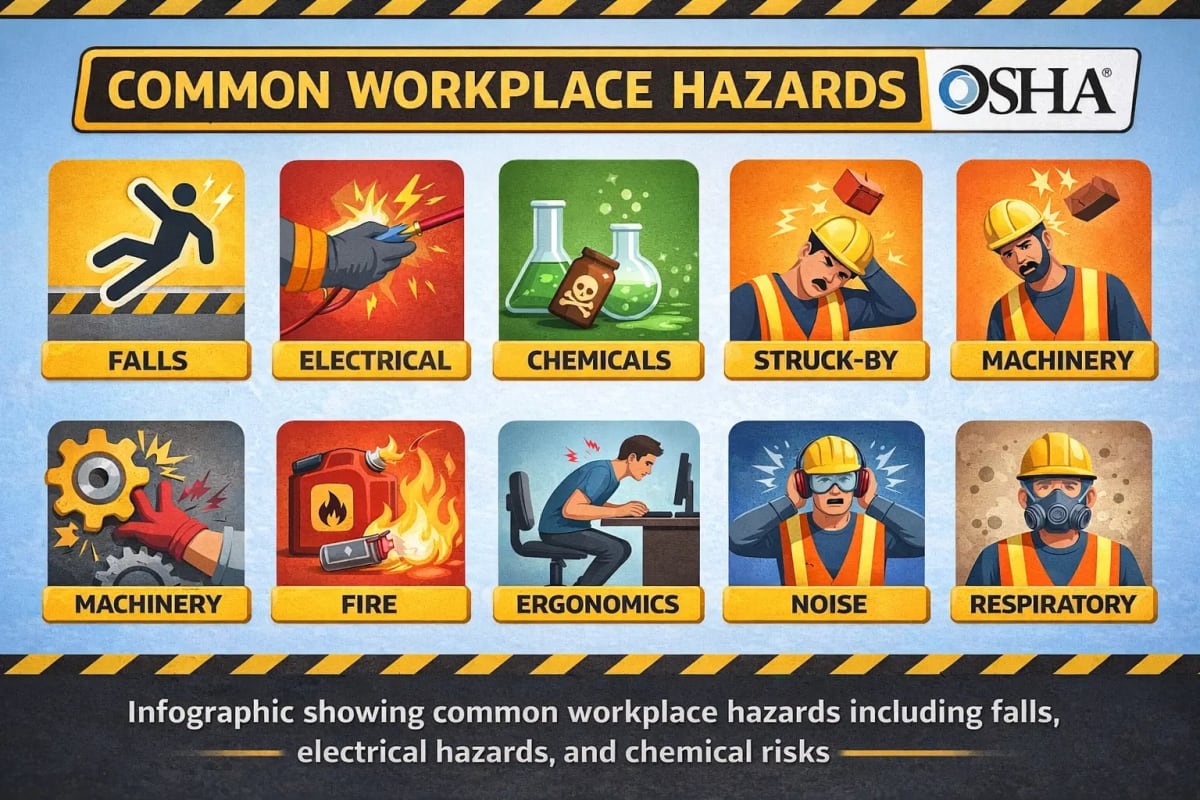
The 8 Most Common Workplace Hazards
1. Falls (Slips, Trips, and Fall from Heights)
Falls are the leading cause of death in construction and among the top causes of injury in every industry. Wet floors, uneven surfaces, loose cables, and poor housekeeping create everyday risks - these hazards often feel harmless until someone gets hurt.
Fall hazards come in two forms: same-level falls (slips and trips on walkways) and elevated falls (from ladders, roofs, scaffolding, and platforms). OSHA requires fall protection at heights of 4 feet in general industry and 6 feet in construction.
Prevention steps:
- Install guardrails, safety nets, or personal fall arrest systems at all elevated work areas
- Maintain clean, dry, well-lit walkways at all times
- Conduct pre-shift inspections of ladders and scaffolding
- Train every worker on fall hazard recognition before they work at height
2. Electrical Hazards
Electrical hazards cause fires, burns, shocks, and fatalities across every industry - from office buildings to construction sites. Exposed wires, overloaded sockets, damaged tools, and temporary connections are common causes of electrical accidents - these hazards exist in offices just as much as on construction sites.
Prevention steps:
- Inspect all power tools and extension cords before each use
- Follow Lockout/Tagout (LOTO) procedures when servicing equipment
- Never work on energized circuits without arc flash protection
- Use Ground Fault Circuit Interrupters (GFCIs) near water sources
3. Chemical Hazards and Hazardous Substances
Chemicals are present in nearly every workplace, from cleaning products in offices to industrial solvents in manufacturing. Safety Data Sheets explain hazards, handling, storage, and emergency measures - workers should know where to find them and how to read key sections. Davron
Prevention steps:
- Maintain a complete chemical inventory and up-to-date SDS library accessible to all workers
- Label every container of hazardous material correctly
- Provide appropriate PPE (gloves, respirators, goggles) for every chemical task
- Note: employers must update workplace labeling, training, and written Hazard Communication programs by November 20, 2026, under OSHA's updated HazCom standard
4. Struck-By and Caught-In/Between Hazards
These hazards are responsible for two of OSHA's "Fatal Four" in construction. Struck-by incidents involve a worker being hit by a moving object (a falling tool, a vehicle, or flying debris). Caught-in incidents involve a body part being pulled into machinery or caught between objects.
How to Identify Hazards in Your Workplace
Conduct initial and periodic workplace inspections to identify new or recurring hazards. Investigate injuries, illnesses, incidents, and close calls to determine the underlying hazards, their causes, and safety program shortcomings. Group similar incidents and identify trends in injuries and illnesses reported.
A practical workplace hazard identification process includes four steps:
Step 1 - Walk the workplace: Physically inspect every area, not just production floors. Storage rooms, parking lots, and restrooms all present hazards.
Step 2 - Talk to workers: Frontline employees see hazards every day that supervisors miss. Create a no-blame reporting system and use it actively.
Step 3 - Review your injury logs: Your OSHA 300 Log is a hazard map. Look for patterns - recurring body parts, same locations, same tasks.
Step 4 - Check OSHA standards: Review sources such as OSHA standards and guidance, NIOSH publications, manufacturers' literature, and engineering reports to identify potential control measures - and keep current on relevant information from trade or professional associations.
The Hierarchy of Hazard Controls
Once you find a hazard, how you control it matters. OSHA and NIOSH both recognize a five-level hierarchy - work from the top down for maximum effectiveness:
Use a combination of control options when no single method fully protects workers, and avoid selecting controls that may directly or indirectly introduce new hazards.
PPE is always the last line of defense, not the first. An employer who hands out gloves without addressing the root chemical hazard is not compliant - and is not genuinely protecting their workers.
2026 Emerging Hazards to Watch
Under the OSHA 2026 worker safety standards, employers must show they can protect workers through proactive hazard assessments, reliable communication systems, and documented emergency protocols. Three hazard categories are receiving new regulatory attention this year:
FAQ - Common Workplace Hazards
Q: What are the most common workplace hazards across all industries?
Falls, electrical hazards, chemical exposure, ergonomic injuries, and struck-by incidents consistently rank as the most prevalent across all industries, appearing every year in OSHA's most-cited violations list.
Q: Who is responsible for workplace hazard prevention?
Employers bear the primary legal responsibility under OSHA. However, workers also have a duty to follow established safety procedures, use required PPE, and report hazards they observe. Effective hazard prevention is always a shared effort.
Q: What is a Job Hazard Analysis (JHA)?
A Job Hazard Analysis is a written document that breaks a task down step by step, identifies the hazard at each step, and lists the control measure for each hazard. JHAs are required for non-routine tasks and are a best practice before any new or modified job begins.
Q: Can workers refuse to perform work they consider hazardous?
Yes. Under OSHA, workers have the right to refuse work they reasonably believe poses an imminent danger of death or serious injury, when there is no time to report it through normal channels and the employer has not corrected the condition.
Q: How often should workplace hazard assessments be conducted?
At minimum, conduct a formal hazard assessment annually. Also conduct one before introducing new equipment, materials, or processes, after any incident or near-miss, and whenever work conditions change significantly.
Conclusion
Common workplace hazards do not disappear on their own. Falls keep happening, chemicals keep harming workers, and heat keeps sending people to emergency rooms because employers underestimate the threat or delay taking action. In 2026, with OSHA enforcement expanding into heat illness, ergonomics, and workplace violence, proactive workplace hazard prevention is the only sustainable strategy.
Start with a thorough hazard assessment. Use the hierarchy of controls. Train your workers. Document everything.
The workplaces with the fewest incidents are never the ones that got lucky - they are the ones that built hazard prevention into every shift, every task, and every decision.