Personal Protective Equipment (PPE): Complete OSHA Guide for 2026
Personal Protective Equipment (PPE)
Personal protective equipment is the most visible part of any workplace safety program - and also one of the most frequently misunderstood. Workers sometimes see PPE as an inconvenience. Employers sometimes treat it as the first line of defense rather than the last. Both of those approaches create problems.
This complete PPE guide covers what personal protective equipment actually is, what OSHA legally requires, who pays for it, every major type and its ANSI standards, and what changed in 2026 that every employer needs to act on now.
What Is Personal Protective Equipment?
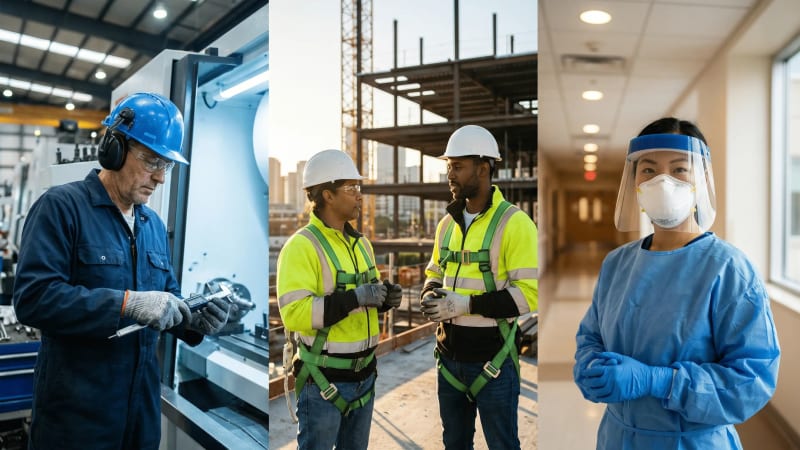
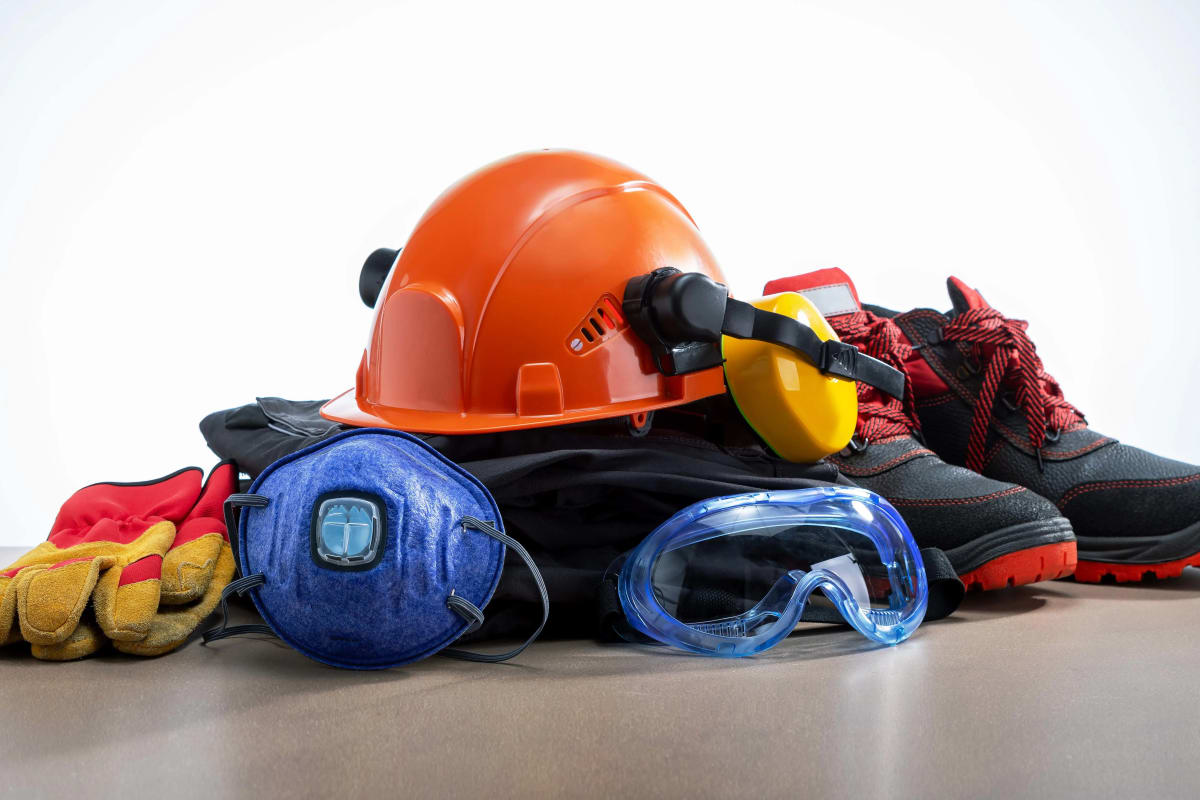
Personal protective equipment is any device or clothing worn by a worker to minimize exposure to hazards that could cause injury or illness. PPE includes many different types of protective equipment such as hard hats, gloves, goggles, safety shoes, safety glasses, welding helmets and goggles, hearing protection devices, respirators, coveralls, vests, harnesses, and full body suits.
When engineering, work practice, and administrative controls are not feasible or do not provide sufficient protection, employers must provide personal protective equipment to their workers and ensure its proper use.
That last point is critical: PPE is always the final safeguard, not the primary one. If you can eliminate or engineer out a hazard, OSHA expects you to do that first. PPE fills the gap where those controls fall short or cannot be fully implemented.
Hierarchy of Controls (Most → Least Effective)
Elimination - Remove the hazard entirely Substitution - Replace with something less dangerous Engineering Controls - Physical barriers, ventilation, machine guards Administrative Controls - Work procedures, scheduling, rotation PPE - Last resort personal protectionPPE ranks last because it does nothing to reduce the hazard itself; it only reduces worker exposure to it. A respirator does not remove toxic fumes from the air. A hard hat does not stop falling objects. They only reduce the consequences if the hazard reaches the worker. This is why a PPE program must always be paired with efforts to reduce hazards at the source.
Who Pays for PPE Under OSHA?
This is one of the most commonly asked questions in OSHA PPE compliance - and the answer is straightforward. The employer is responsible for requiring the wearing of appropriate personal protective equipment in all operations where there is an exposure to hazardous conditions. With few exceptions, OSHA requires employers to pay for PPE when it is used to comply with an OSHA standard. The employer must pay for replacement PPE, except when the employee has lost or intentionally damaged the PPE.
There are narrow exceptions: the employer is not required to pay for non-specialty safety-toe protective footwear, including steel-toe shoes or steel-toe boots, and non-specialty prescription safety eyewear, provided that the employer permits such items to be worn off the job site. Ordinary clothing, skin creams, or other items used solely for protection from weather, such as winter coats, jackets, gloves, parkas, rubber boots, hats, raincoats, ordinary sunglasses, and sunscreen, are also excluded.
Bottom line: if OSHA requires it for your specific job task, the employer pays for it.
The 2026 PPE Fit Rule: What Changed and Why It Matters
One of the most important recent updates to OSHA PPE standards came into effect on January 13, 2025, and is actively enforced in 2026. A major update to OSHA's PPE standard went into effect on January 13, 2025, with the purpose of reinforcing the importance of properly fitting equipment. The revised standard, termed as 29 CFR 1926.95(c), now explicitly requires employers in the construction industry to ensure that PPE properly fits each individual worker. This change aligns construction industry requirements with those already in place for general industry and maritime sectors. The update is especially impactful for workers who previously struggled to find appropriately sized gear, such as women and individuals with non-standard body types.
Why does fit matter so much? Improperly fitting PPE may fail to provide any protection to an employee, reduce the effectiveness of protection, present additional hazards, or discourage employees from using such equipment in the workplace.
Ill-fitting equipment can lead to inadequate protection or even create additional hazards. For example, oversized sleeves or gloves may interfere with tool use or equipment operation, while undersized protective clothing could restrict movement or increase exposure to workplace hazards.
What employers must do in 2026: Review your entire PPE inventory against your current workforce. Document that each worker has been assessed for fit. Update procurement policies to ensure properly fitting options are available for all body types.
Types of PPE and OSHA Requirements for Each
Head Protection - Hard Hats
To protect workers from head injuries, hard hats must be worn when there is a risk of falling objects, collisions, or contact with electrical hazards. Hard hats should be well-fitting, comfortable, and adjustable to accommodate different head sizes.
OSHA requires that many categories of personal protective equipment meet or be equivalent to standards developed by the American National Standards Institute (ANSI). For hard hats, the relevant standard is ANSI Z89.1. Hard hats come in two types: Type I (top protection only) and Type II (top and lateral protection). Class E (Electrical) hard hats are required for electrical work.
The hat should not bind, slip, fall off, or irritate the skin. Some protective headgear allows for the use of various accessories to help employees deal with changing environmental conditions, such as slots for earmuffs, safety glasses, face shields, and mounted lights. Periodic cleaning and inspection will extend the useful life.
Inspect hard hats before every shift for cracks, dents, or penetration. Replace immediately after any significant impact, even if no visible damage is present.
Eye and Face Protection
Safety spectacles are protective eyeglasses with safety frames constructed of metal or plastic and impact-resistant lenses. Goggles provide tight-fitting eye protection. Welding shields protect eyes from burns caused by infrared or intense radiant light and also protect both the eyes and face from flying sparks, metal spatter, and slag chips produced during welding, brazing, soldering, and cutting operations. Face shields are transparent sheets of plastic that extend from the eyebrows to below the chin and across the entire width of the employee's head, protecting against potential splashes or sprays of hazardous liquids, droplets, and particles, but will not provide adequate protection against impact hazards alone.
Key rule: a face shield is never a substitute for safety glasses or goggles; it is a supplement. Workers must wear both when impact and splash hazards are present.
Hearing Protection
Workers exposed to high noise levels may need earplugs or earmuffs to prevent hearing damage. The type of hearing protection selected should depend on the noise levels and the worker's comfort. It is crucial to train workers on the proper fitting and care of hearing protection equipment.
OSHA's hearing conservation standard (29 CFR 1910.95) requires a hearing conservation program whenever noise exposure reaches or exceeds 85 decibels averaged over an 8-hour shift. The Noise Reduction Rating (NRR) on hearing protection packaging tells you how much protection a device provides, but real-world protection is typically 50% of the labeled NRR due to improper fit.
Respiratory Protection
Respirators protect workers from inhaling hazardous substances like dust, fumes, or gases. Respirators should be chosen based on the type and level of hazard present and must be approved by the National Institute for Occupational Safety and Health (NIOSH). Workers should be trained on properly using, maintaining, and storing respirators.
Respirators fall into two broad categories:
- Air-purifying respirators (APRs): Filter contaminants from ambient air. Range from simple N95 filtering facepieces to powered air-purifying respirators (PAPRs). Only effective when oxygen levels are adequate.
- Supplied-air respirators (SARs): Deliver clean air from an external source. Required in oxygen-deficient or immediately dangerous to life and health (IDLH) environments.
OSHA's respiratory protection standard (29 CFR 1910.134) requires a written program, medical evaluation, annual fit testing, and documented training before any worker uses a respirator.
Hand Protection - Gloves
Hand injuries are among the most common workplace injuries in every industry. Glove selection must be matched to the specific hazard:
✂️ Cut / Abrasion Recommended glove: Cut-resistant (ANSI A-rated) 🧪 Chemical Exposure Recommended glove: Chemical-resistant (check permeation ratings) ⚡ Electrical Recommended glove: Insulating rubber gloves (voltage-rated) 🔥 Heat / Fire Recommended glove: Aluminized or Kevlar 🧤 General Grip Recommended glove: Leather or synthetic work glovesA critical mistake: using the wrong glove can be more dangerous than not wearing a glove. Chemical-resistant gloves for one substance may offer zero protection against another. Always verify permeation data from the manufacturer's SDS.
Foot Protection - Safety Footwear
Safety footwear protects against compression, puncture, and impact injuries. OSHA's revised rule makes proper PPE fit an enforceable requirement, and employers should focus on selecting PPE that adequately protects workers without introducing new risks. This applies directly to safety footwear ill-fitting boots cause slips, fatigue, and musculoskeletal strain.
Footwear is classified by ANSI Z41/ASTM F2413 standards. Common protection types include impact/compression (steel or composite toe), puncture resistance (steel midsole), metatarsal protection, and electrical hazard (EH) rating.
High-Visibility Clothing
High-visibility vests and clothing are required wherever workers face struck-by hazards from vehicles or moving equipment. ANSI/ISEA 107 classifies high-vis garments into three performance classes: Class 1 (lowest risk), Class 2 (moderate risk, most common on construction sites), and Class 3 (highest risk, required near high-speed traffic).
Color matters too: fluorescent yellow-green provides maximum daytime visibility while fluorescent orange-red is preferred in environments with similar-colored backgrounds.
Fall Protection Equipment
Fall protection equipment, such as harnesses, lanyards, and anchor points, is necessary for workers at heights of six feet or more above a lower level in construction. It is crucial to select the appropriate fall protection system based on the specific work environment and train workers on its proper use, inspection, and maintenance.
A personal fall arrest system (PFAS) consists of three components working together: a full-body harness, a connecting lanyard or self-retracting lifeline (SRL), and a certified anchor point rated to support 5,000 lbs per worker. All three must be inspected before every use and immediately removed from service after any fall.
All three must be inspected before every use and immediately removed from service after any fall.
How to Conduct a PPE Hazard Assessment
If PPE is to be used, a PPE program should be implemented. This program should address hazards, selection, maintenance, training, and ongoing monitoring to ensure effectiveness.
A formal PPE hazard assessment follows these steps:
Step 1 - Walk every work area Identify all sources of energy, chemicals, biological agents, and physical hazards present. Step 2 - Assess each hazard Document the type, severity, and likelihood of harm for each hazard identified. Step 3 - Determine existing controls Review engineering and administrative controls already in place before PPE is considered. Step 4 - Select appropriate PPE Match PPE type and protection level to residual hazards. Verify ANSI compliance. Step 5 - Document and certify Create a written certification, including workplace, assessor, date, and documentation details.Review and update your hazard assessment whenever new processes, chemicals, or equipment are introduced.
Building a Written PPE Program
A compliant written PPE program must address five elements under OSHA 29 CFR 1910.132:
- The hazards present in the workplace and their assessment
- The selection criteria for each type of PPE required
- How PPE will be maintained, inspected, and replaced
- How workers will be trained on proper use
- How program effectiveness will be monitored over time
Keep the program specific to your workplace, not a generic template. OSHA inspectors review written programs closely and cite employers when programs are not site-specific or are outdated.
PPE Training Requirements
Employers are required to train each worker required to use personal protective equipment to know when PPE is necessary, what PPE is necessary, how to properly don, doff, adjust, and wear PPE, the limitations of the PPE, and the proper care, maintenance, useful life, and disposal of the PPE.
Retraining is required when there are changes in the workplace that render prior training obsolete, or when the employee demonstrates a lack of knowledge or skill in the use of required PPE that makes the prior training obsolete.
Training must be documented with the worker's name, the date, the topics covered, and the trainer's name. Retain all training records for the duration of employment plus three years.
FAQ - Personal Protective Equipment
👁️ Q: What is the most commonly violated PPE standard?
Eye and face protection violations appear in OSHA's top 10 most-cited violations list every year. Workers and supervisors frequently underestimate eye hazards in tasks that seem routine.
🧑⚖️ Q: Can an employee refuse to wear PPE?
Employees are legally required to use PPE their employer provides as part of OSHA compliance. Refusal to use required PPE can be grounds for disciplinary action. Employers must enforce PPE use consistently and document violations.
⏳ Q: Does PPE expire?
Yes. Most PPE has a manufacturer-recommended service life. Respirator cartridges expire based on use and exposure. Hard hats typically have a 5-year crown replacement and 2-year suspension schedule. Chemical-resistant gloves degrade over time even without visible damage. Always follow manufacturer guidelines.
🧰 Q: Can workers use their own PPE?
Where an employee provides adequate protective equipment they own, the employer may allow the employee to use it and is not required to reimburse the employee for that equipment. However, the employer shall be responsible to assure its adequacy, including proper maintenance and sanitation of such equipment. Lee Company
📏 Q: What does ANSI compliance mean for PPE?
ANSI (American National Standards Institute) sets performance standards for PPE categories. OSHA requires that many types of PPE meet or exceed ANSI standards. When purchasing PPE, verify the product carries the correct ANSI certification for the hazard it is intended to address.
🔍 Q: How often should PPE be inspected?
Pre-use inspection before every shift is the minimum standard for life-safety PPE like fall protection harnesses and electrical gloves. Other PPE should be inspected regularly and formally documented at least monthly. Replace any item that fails inspection immediately.
Conclusion
Personal protective equipment is essential but it only works when it is the right type, the right fit, properly maintained, and correctly used by trained workers. In 2026, with OSHA's new PPE fit requirement now actively enforced across construction, general industry, and maritime sectors, employers who have not reviewed their PPE programs against their current workforce face real citation risk.
Start with a formal hazard assessment. Build a written program that is specific to your workplace. Train every worker before they face the hazard. And remember: the best PPE in the world provides zero protection if it is sitting in a storage cabinet instead of being worn on the job.
The best PPE provides zero protection if it is not being worn.