In 2023 alone, confined space incidents claimed the lives of dozens of American workers. Many of those deaths could have been prevented with proper planning and compliance. If you manage a worksite with tanks, silos, manholes, or vaults, understanding confined space safety requirements OSHA enforces is not just about avoiding fines. It is about bringing every worker home safely.
This guide breaks down everything you need to know, from how OSHA defines a confined space to the permits, training, equipment, and rescue plans that keep your team protected and your company compliant.
What Is a Confined Space Under OSHA?
The 3 Criteria That Define a Confined Space
According to OSHA, a confined space must meet all three of these criteria:
- Large enough for a worker to physically enter and perform work
- Has limited or restricted means of entry or exit (small openings, hatches, narrow passages)
- Is not designed for continuous human occupancy
A space only qualifies as confined when it meets all three conditions at the same time. A room with a standard door and regular ventilation would not count, even if it feels small.
Common Examples of Confined Spaces in the Workplace
You might be surprised how many confined spaces exist on a typical job site. Common examples include:
- Storage tanks and process vessels
- Silos and grain bins
- Manholes and underground vaults
- Sewer systems and storm drains
- Boilers and furnaces
- Crawl spaces and pipeline interiors
- Pits and trenches deeper than four feet
Confined Space vs Permit-Required Confined Space
What Makes a Space Permit-Required?
Not every confined space requires a permit. A space becomes permit-required when it contains one or more of these serious hazards:
- A hazardous atmosphere (toxic gas, low oxygen, flammable vapors)
- A material that could engulf or trap a worker (grain, sand, water)
- Walls that converge inward or floors that slope into a smaller area, creating entrapment risk
- Any other recognized serious safety or health hazard
Employers are required to evaluate every confined space on their property and determine whether it meets the permit-required threshold under the OSHA confined space standard.
Quick Comparison Table
| Feature | Confined Space | Permit-Required Confined Space |
|---|---|---|
| Meets 3 basic criteria | Yes | Yes |
| Contains serious hazards | No | Yes (one or more) |
| Written permit needed | No | Yes, before every entry |
| Atmospheric testing required | Not mandatory | Required before and during entry |
| Rescue plan required | Not mandatory | Yes, must be in place before entry |
| Attendant stationed outside | Not mandatory | Yes, at all times during entry |
OSHA Confined Space Standards: 1910.146 vs 1926 Subpart AA
General Industry Standard (29 CFR 1910.146)
This is the primary confined space regulation for general industry workplaces like manufacturing plants, utilities, and warehouses. It has been in effect since 1993 and outlines requirements for entry permit procedures, atmospheric monitoring, training, and rescue operations.
Construction Industry Standard (29 CFR 1926 Subpart AA)
OSHA introduced a separate confined space standard for construction in 2015. Before that, construction workers followed general industry rules that did not fully address the unique challenges of construction job sites.
Key Differences Between the Two Standards
- The construction standard requires a competent person to evaluate confined spaces, while general industry requires an entry supervisor
- Construction rules require the controlling contractor to coordinate entry operations when multiple employers share a job site
- The construction standard allows continuous atmospheric monitoring as an alternative to some permit requirements in certain situations
- Rescue services under the construction rule must be able to respond in a timely manner, with specific evaluation criteria
Confined Space Hazards Every Worker Must Know
Atmospheric Hazards (Toxic, Flammable, Oxygen-Deficient)
Atmospheric hazards are the leading cause of confined space fatalities. According to NIOSH, roughly 60% of confined space deaths involve hazardous atmospheres rather than physical hazards. The most dangerous atmospheric conditions include:
- Oxygen deficiency: Below 19.5% oxygen can cause impaired judgment, unconsciousness, and death
- Oxygen enrichment: Above 23.5% creates extreme fire and explosion risk
- Toxic gases: Hydrogen sulfide (H2S) and carbon monoxide (CO) are the most common killers
- Flammable gases and vapors: Methane, gasoline vapors, and other combustibles
Physical Hazards (Engulfment, Entrapment, Moving Parts)
Beyond bad air, workers face physical dangers including:
- Engulfment by grain, sand, or liquid
- Entrapment from converging walls or sloping floors
- Moving mechanical parts like mixers, augers, or agitators that may activate unexpectedly
- Electrical hazards and extreme temperatures
Using proper lockout tagout in confined spaces before entry is critical to prevent unexpected equipment activation.
How Atmospheric Testing Works
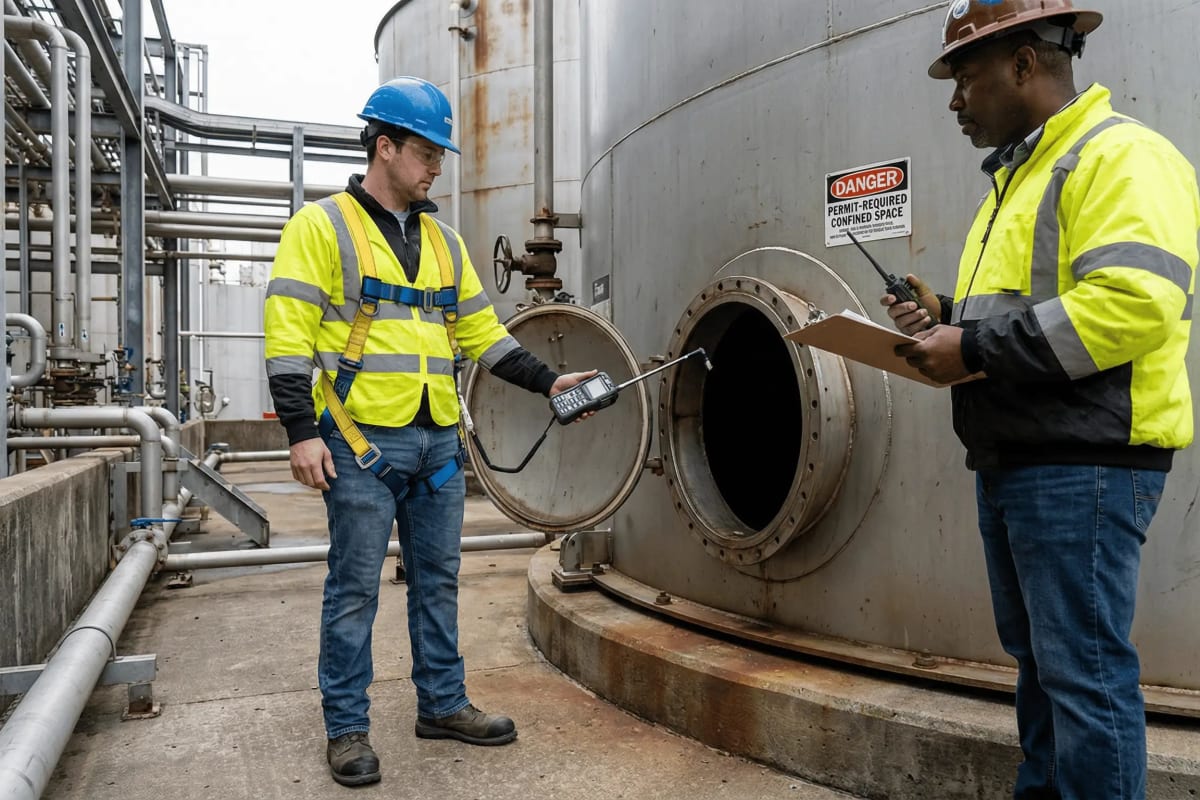
Atmospheric testing must follow a specific order every time. You always test oxygen levels first, then combustible gases, then toxic gases. This order matters because gas monitors need adequate oxygen to give accurate combustible gas readings.
Testing should happen at multiple levels within the space, starting at the top, middle, and bottom. Some gases are heavier than air and settle at the bottom, while others rise. A four-gas monitor calibrated before each use is the industry standard tool for atmospheric monitoring.
OSHA Confined Space Entry Requirements: Step by Step
Employer Responsibilities Before Entry
Before anyone enters a permit-required confined space, the employer must:
- Identify all confined spaces on the property
- Evaluate each space for hazards
- Develop a written permit space program
- Post danger signs at permit-required spaces
- Provide all necessary equipment at no cost to workers
What Must Be on the Entry Permit
The entry permit is the backbone of confined space safety. According to OSHA, a valid permit must include:
- The specific space being entered and its purpose
- Date and authorized duration of entry
- Names of authorized entrants and the current attendant
- Name of the entry supervisor who authorized the permit
- Identified hazards and the control measures in place
- Acceptable atmospheric test results with the time of testing
- Rescue and emergency procedures
- Communication methods between entrant and attendant
- Equipment required (ventilation, PPE, monitoring devices)
A permit is only valid for one entry period. Once the job is done or conditions change, the permit must be closed and a new one issued.
Roles: Authorized Entrant, Attendant, and Entry Supervisor
OSHA defines three specific roles for every permit-required confined space entry:
- Authorized entrant: The worker who enters the space, trained to recognize hazards and use equipment properly
- Attendant: Stationed outside the space at all times, monitors entrants, maintains communication, and calls for rescue if needed. The attendant must never enter the space.
- Entry supervisor: Authorizes the entry, verifies the permit is complete, and ensures all safety measures are in place before giving the go-ahead
Confined Space Training Requirements Under OSHA
Who Needs Training and How Often
Every worker involved in confined space operations needs training before their first assignment. This includes entrants, attendants, entry supervisors, and rescue team members. Training is not a one-time event. OSHA requires retraining whenever:
- Job duties change
- New hazards are identified
- Procedures are updated or revised
- An employer has reason to believe workers do not understand the requirements
What the Training Must Cover
Training content must match each worker's role and responsibilities. At a minimum, it should cover:
- How to recognize confined space hazards
- Proper use of all required equipment
- Emergency and rescue procedures
- Communication protocols
- The specific duties of their assigned role
According to the Bureau of Labor Statistics, workplace safety training programs reduce injury rates by an average of 20 to 40 percent when properly implemented and reinforced.
Rescue Plan Requirements for Confined Spaces
Self-Rescue vs Non-Entry Rescue vs Entry Rescue
OSHA requires employers to have a rescue plan ready before anyone enters a permit-required confined space. There are three types:
- Self-rescue: The entrant exits the space on their own when conditions change. This is only appropriate for minor, slow-developing hazards.
- Non-entry rescue: The most preferred method. A retrieval system with a full-body harness and retrieval line allows the attendant to pull the entrant out without entering the space.
- Entry rescue: A trained rescue team physically enters the space to retrieve the worker. This is the most dangerous option and requires extensive training and equipment.
OSHA strongly prefers non-entry rescue using mechanical retrieval systems whenever possible.
Common Rescue Plan Failures That Lead to Citations
Rescue planning is one of OSHA's most frequently cited deficiencies in confined space inspections. The most common failures include:
- No rescue plan exists at all
- Off-site rescue services have not been evaluated for response time
- Retrieval equipment is not set up and ready before entry begins
- Rescue teams have not conducted practice drills within the past 12 months
- The plan does not account for the specific layout of the confined space
A rescue plan that only exists on paper but has never been practiced is a citation waiting to happen.
Equipment Required for Confined Space Entry
Personal Protective Equipment (PPE)
- Full-body harness with a D-ring for retrieval systems
- Hard hat and safety glasses
- Appropriate respiratory protection (SCBA or air-purifying respirator)
- Chemical-resistant gloves when hazardous substances are present
Atmospheric Monitoring Devices
A calibrated four-gas monitor is essential. It tests for oxygen levels, combustible gases, hydrogen sulfide, and carbon monoxide simultaneously. Monitors must be bump-tested or calibrated before each use according to the manufacturer's instructions.
Ventilation and Communication Equipment
- Mechanical ventilation (blowers and ductwork) to maintain safe atmosphere levels throughout the entry
- Two-way radios or hardwired communication systems
- Adequate lighting rated for the environment (explosion-proof if flammable atmospheres are possible)
- Tripod and winch system for non-entry rescue retrieval
Real OSHA Confined Space Violations and Penalties
Recent Enforcement Cases
OSHA takes confined space violations seriously. In recent years, the agency has issued significant penalties to companies that failed to protect workers:
- A Texas manufacturing company was fined over $300,000 after a worker died in a storage tank that had no entry permit, no atmospheric testing, and no rescue plan
- An Ohio wastewater treatment facility received citations exceeding $200,000 for repeated failures to train workers and implement a permit program
- A food processing plant in the Midwest faced willful violation penalties after an engulfment death in a grain bin where lockout tagout procedures were not followed
Penalty Amounts and Citation Types
According to OSHA's current penalty structure, fines for confined space violations can be severe:
- Serious violation: Up to $16,131 per violation
- Willful or repeated violation: Up to $161,323 per violation
- Failure to abate: Up to $16,131 per day beyond the abatement deadline
These amounts are adjusted annually for inflation. A single inspection can result in multiple violations, meaning total penalties can reach hundreds of thousands of dollars.
Confined Space Safety Checklist for Employers
Use this checklist before every permit-required confined space entry:
- All confined spaces on site identified and evaluated
- Permit-required spaces clearly marked with danger signs
- Written permit space program developed and available
- Entry permit completed with all required information
- Atmospheric testing completed at multiple levels (oxygen, combustibles, toxics)
- Ventilation equipment set up and running
- All PPE and monitoring equipment inspected and ready
- Authorized entrant, attendant, and entry supervisor assigned
- Communication system tested and functioning
- Rescue plan in place with retrieval equipment ready
- All personnel trained and current on their assigned roles
- Lockout tagout procedures completed on all energy sources
- Emergency services notified if using off-site rescue
Frequently Asked Questions
Protecting Lives Through Proper Confined Space Compliance
Meeting OSHA's confined space safety requirements is about more than passing inspections. Every permit, every atmospheric test, and every rescue drill exists because real workers have lost their lives when these steps were skipped. Whether you are managing a construction site, a manufacturing plant, or a utility operation, making confined space safety a non-negotiable priority is the most important decision you can make.
Is your worksite fully compliant with OSHA confined space requirements? Share this guide with your safety team and use the checklist above to audit your current procedures. Drop a comment below if you have questions about your specific situation.
Use the checklist and permit walkthrough in this guide to identify gaps in your current compliance. Protect your workers and avoid costly OSHA citations.
Get the Safety Checklist