Key Takeaways
- The OSHA heat stress standard refers to the federal Heat Injury and Illness Prevention rule that OSHA proposed in July 2024 and is finalizing for nationwide enforcement.
- When the heat index reaches 80°F, basic protections kick in; at 90°F, workers must be given a 15-minute paid rest break every 2 hours.
- Every covered employer must have a written Heat Illness Prevention Plan, often called a HIPP, available in a language workers actually understand.
- Serious violations can run up to about $16,131 per violation, and willful or repeat violations can climb above $161,323 per violation.
- What Is the OSHA Heat Stress Standard?
- Federal Standard vs General Duty Clause
- Indoor and Outdoor Coverage
- Heat Triggers Explained (80°F vs 90°F)
- Initial Heat Trigger: 80°F Heat Index
- High Heat Trigger: 90°F Heat Index
- Using Wet Bulb Globe Temperature (WBGT)
- What the Heat Illness Prevention Plan Must Include
- Written Plan Requirements
- Heat Safety Coordinator Role
- Required Employer Obligations Under the Standard
- Water Access and Cool Drinks
- Paid Rest Breaks in Shade or Cool Areas
- Acclimatization for New and Returning Workers
- Training in a Language Workers Understand
- Emergency Response and Heat Illness Reporting
- How Federal Rules Compare to State Plans
- OSHA Heat Enforcement and Citation Amounts
- OSHA Heat Compliance Checklist for Employers
- Frequently Asked Questions
- Conclusion: Prepare Now Before Enforcement Ramps Up
In July 2023, a 24-year-old farmworker in Florida collapsed on his second day on the job and died before reaching the hospital. His core body temperature was 107°F. His employer had no heat plan, no shaded rest area, and no acclimatization schedule. That fatality is exactly the kind of preventable tragedy OSHA's new heat rule is trying to stop. If you employ workers in construction, agriculture, warehousing, kitchens, or any setting where the temperature climbs, the OSHA heat stress standard is now one of the most important compliance topics on your desk. Here is the complete employer guide for 2026.
What Is the OSHA Heat Stress Standard?
The OSHA heat stress standard refers to the federal Heat Injury and Illness Prevention rule that OSHA proposed in July 2024 and is finalizing for nationwide enforcement. It requires employers to protect workers from heat hazards in both outdoor and indoor work settings through written plans, rest breaks, water access, acclimatization, and training.
Even before the rule is fully final, OSHA already cites employers for heat hazards. The agency uses Section 5(a)(1) of the OSH Act, known as the General Duty Clause, to penalize companies that fail to protect workers from recognized heat dangers.
Federal Standard vs General Duty Clause
The General Duty Clause is broad and reactive. The new heat standard is specific and proactive. Once finalized, it gives employers exact thresholds to act on, not just a vague "do something" warning.
Indoor and Outdoor Coverage
This is what makes the new rule different. It covers outdoor jobs like roofing and farming, but it also reaches indoor sites, including warehouses without air conditioning, commercial kitchens, foundries, laundries, and delivery vans.
Heat Triggers Explained (80°F vs 90°F)
The standard uses two clear thresholds based on heat index, which combines temperature and humidity.
Initial Heat Trigger: 80°F Heat Index
When the heat index reaches 80°F, basic protections kick in: cool drinking water, paid rest breaks as needed, an acclimatization plan for new workers, and access to shaded or cooler indoor areas.
High Heat Trigger: 90°F Heat Index
At 90°F heat index, protections step up. Workers must be given a 15-minute paid rest break every 2 hours, a buddy system or check-in protocol becomes mandatory, and the employer must place warning signs about the increased risk.
Using Wet Bulb Globe Temperature (WBGT)
Employers in industries like construction or steel can choose WBGT measurement instead of heat index. WBGT accounts for sunlight, wind, and radiant heat and is considered the gold standard by the National Institute for Occupational Safety and Health (NIOSH).
What the Heat Illness Prevention Plan Must Include
This is the centerpiece of compliance. Every covered employer must have a written Heat Illness Prevention Plan, often called a HIPP, available in a language workers actually understand.
The plan must spell out:
- Who is the designated heat safety coordinator
- How heat conditions will be monitored at the site
- Where water and shade or cool-down areas are located
- The acclimatization schedule for new and returning workers
- Emergency response steps if a worker shows heat illness symptoms
- Training topics and refresher frequency
- Worker involvement in plan review
Written Plan Requirements
The plan cannot be a generic template downloaded once and forgotten. It must be site-specific, updated when work conditions change, and accessible to workers and OSHA inspectors on demand.
Heat Safety Coordinator Role
Every workplace under the rule needs a named person responsible for heat oversight. This person monitors conditions, enforces breaks, and authorizes work stoppages when heat becomes dangerous.
Required Employer Obligations Under the Standard
Water Access and Cool Drinks
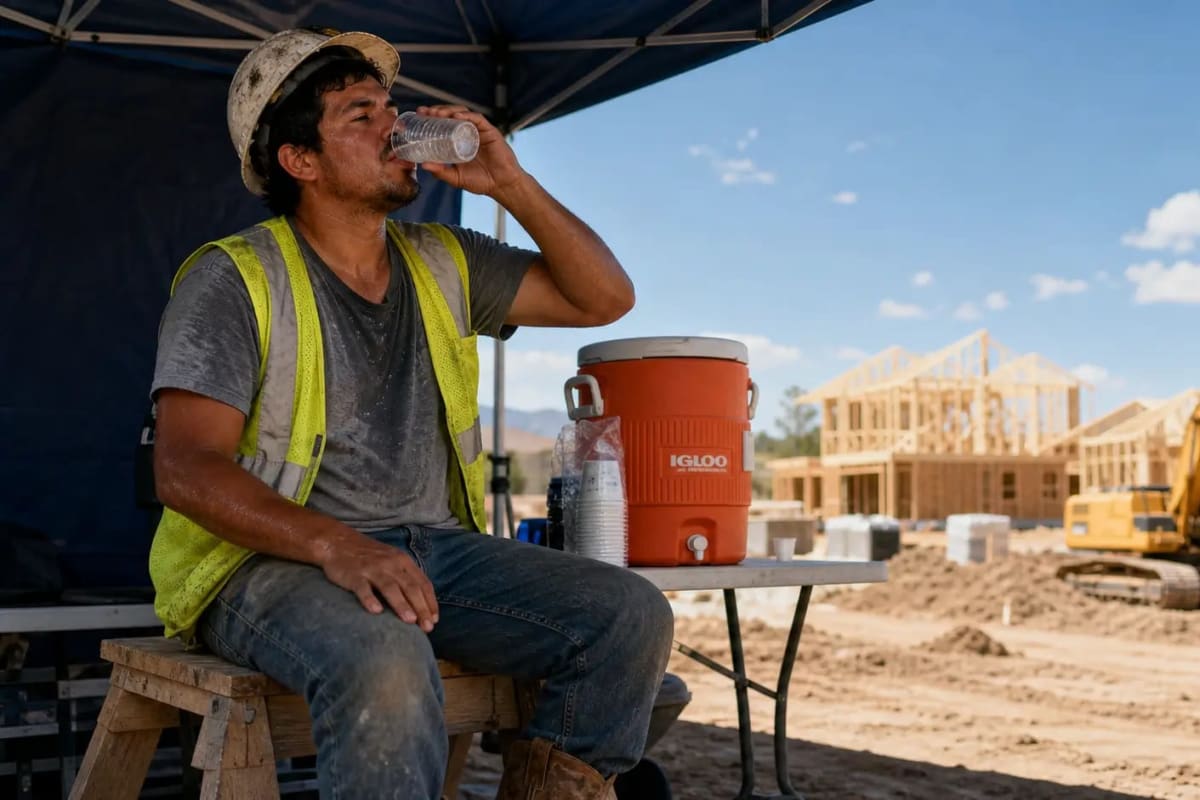
Employers must provide free, cool drinking water close to the work area. The OSHA recommendation is 1 quart per hour per worker, which adds up to 8 quarts over a full shift.
Paid Rest Breaks in Shade or Cool Areas
At the high heat trigger, rest breaks are mandatory and paid. Workers cannot be pushed to keep working through "just one more pallet."
Acclimatization for New and Returning Workers
This is the requirement most employers miss. Following the NIOSH "Rule of 20%," new workers should perform no more than 20% of normal work on day 1, increasing by 20% each day until day 5. The same applies to workers returning from more than 14 days away.
Training in a Language Workers Understand
Training must cover heat illness signs, prevention steps, the right to take rest breaks, and how to report symptoms. It must be given in a language and at a literacy level workers can follow.
Emergency Response and Heat Illness Reporting
Employers must have a clear plan for cooling a worker quickly, calling 911, and reporting any heat-related hospitalization to OSHA within 24 hours, or any heat fatality within 8 hours.
How Federal Rules Compare to State Plans
Several OSHA State Plans already enforce heat standards that meet or exceed the federal proposal.
| State | Standard Year | Key Requirement |
|---|---|---|
| California (Cal/OSHA) | 2006 outdoor, 2024 indoor | Shade required at 80°F outdoors |
| Washington | 2008, updated 2023 | Permanent rule for outdoor work |
| Oregon | 2022 | Indoor and outdoor heat rule |
| Colorado | 2022 (agriculture) | Statewide agricultural protections |
| Nevada | 2024 | New heat illness prevention rule |
| Minnesota | Long-standing | Indoor workplace standard |
If your business operates in multiple states, you must follow the stricter of state or federal rules. State plan employers cannot drop below federal protections once the federal rule is in force.
OSHA Heat Enforcement and Citation Amounts
OSHA launched a National Emphasis Program (NEP) on Heat in April 2022, which is still in effect. The NEP authorizes targeted heat inspections at high-risk worksites.
The Bureau of Labor Statistics tracks roughly 36 heat-related occupational fatalities each year, and CDC NIOSH notes the real number is likely higher because many cases are misclassified.
Citation amounts in 2024-2025 are not small. Serious violations can run up to about $16,131 per violation, and willful or repeat violations can climb above $161,323 per violation. Multiple workers and multiple violations stack quickly. A single inspection can produce six-figure penalties.
OSHA Heat Compliance Checklist for Employers
Use this checklist before the next hot day on the job.
- Identify all jobs and locations where workers face heat exposure
- Designate a heat safety coordinator in writing
- Draft a site-specific Heat Illness Prevention Plan
- Set up shaded or air-conditioned rest areas within reasonable walking distance
- Stock cool drinking water at 1 quart per hour per worker
- Build an acclimatization schedule using the Rule of 20%
- Train every worker in their primary language before the season starts
- Post signage about the 80°F and 90°F triggers
- Set up a buddy system or check-in process for high heat days
- Pre-program emergency cooling and 911 steps
- Document all training, breaks, and water access
- Review the plan with workers and update annually
If you cannot check at least 10 of these confidently, you are not compliance-ready.
Frequently Asked Questions
Yes. OSHA's Heat Injury and Illness Prevention rule is moving toward final enforcement in 2026, and the General Duty Clause already lets OSHA cite employers for heat hazards in the meantime.
The initial trigger is an 80°F heat index and the high heat trigger is a 90°F heat index. Some employers use Wet Bulb Globe Temperature instead.
Yes. Cool drinking water must be free and available, and at the 90°F high heat trigger, 15-minute paid rest breaks every 2 hours are required.
Acclimatization is the process of letting new or returning workers build heat tolerance gradually. OSHA points to the NIOSH Rule of 20%, where workers do only 20% of full work on day 1 and add 20% each day until day 5.
California, Washington, Oregon, Colorado, Nevada, and Minnesota all have state heat standards. Several others are drafting their own under State Plan authority.
Conclusion: Prepare Now Before Enforcement Ramps Up
The OSHA heat stress standard is no longer a future concern. The thresholds are set, the National Emphasis Program is active, and inspectors are visiting worksites every summer. Employers who wait until a citation arrives will pay far more than the cost of a written plan, a shade canopy, and a case of bottled water.
Get the plan written, train your team, and treat heat like the serious workplace hazard it is.
Share this guide with your safety manager or HR lead before the next heat wave, and drop your toughest heat compliance question in the comments.
Get Compliance Updates
![How to Run a Facility Safety Audit in 7 Steps [Checklist]](https://res.cloudinary.com/saad5690/image/upload/c_fill,w_800,h_450,g_auto,q_auto,f_auto/posts/bunulfx4xwgcm1qdtnjp)
