
A small manufacturing company in Ohio was fined $148,000 after an OSHA inspection revealed that employees operating heavy machinery had never received formal safety training. The owner assumed verbal instructions were enough. They were not. If you manage a team, run a business, or work in HR, understanding workplace safety training requirements for employees is not optional. This guide breaks down exactly what OSHA requires, by industry, by role, and by timeline, so you stay compliant and protect your people.
What Are the OSHA Workplace Safety Training Requirements for Employees?
OSHA does not have a single master list of required training. Instead, it sets requirements through individual standards, each tied to a specific hazard or industry. The umbrella that covers everything is the General Duty Clause.
The General Duty Clause: What It Requires of Every Employer
Section 5(a)(1) of the Occupational Safety and Health Act requires every employer to provide a workplace free from recognized hazards that are likely to cause serious harm or death. Training is a core part of meeting that obligation. If employees face a hazard and have not been trained to recognize and respond to it, the employer is exposed to a violation, even if a specific OSHA standard does not spell it out in writing.
Core OSHA Training Requirements That Apply to All Workplaces
These training requirements apply broadly, regardless of industry:
- Emergency action plans and fire safety procedures
- Hazard communication and chemical safety awareness
- Personal protective equipment selection and proper use
- Bloodborne pathogen exposure for applicable roles
- Lockout/tagout procedures for machinery with stored energy
- Walking and working surfaces, including fall prevention
- Electrical safety basics where relevant hazards exist
Each of these links to a specific standard under 29 CFR 1910 for general industry or 29 CFR 1926 for construction.
Mandatory Workplace Safety Training Topics Every Employee Must Receive
Emergency Action Plans and Fire Safety (29 CFR 1910.38)
Every workplace with 10 or more employees must have a written emergency action plan. Employees must be trained on evacuation routes, alarm systems, and emergency contacts. Training must happen before employees begin work and whenever the plan is updated.
Hazard Communication and Chemical Safety (29 CFR 1910.1200)
Known as HazCom or the hazard communication standard, this requirement applies to any workplace where employees may be exposed to hazardous chemicals. Employees must be trained on how to read safety data sheets, understand chemical labels, and protect themselves from exposure. This is one of the most frequently cited OSHA violations every year.
HazCom violations appear on OSHA's top-ten list year after year. Simply having safety data sheets on file is not enough. Employees must be formally trained to read and use them.
Personal Protective Equipment Training (29 CFR 1910.132)
PPE training is not just about handing out gloves or hard hats. Employers must formally train employees on which PPE is required for their job tasks, how to wear it correctly, how to maintain it, and when to replace it. A documented training record is required for each employee.
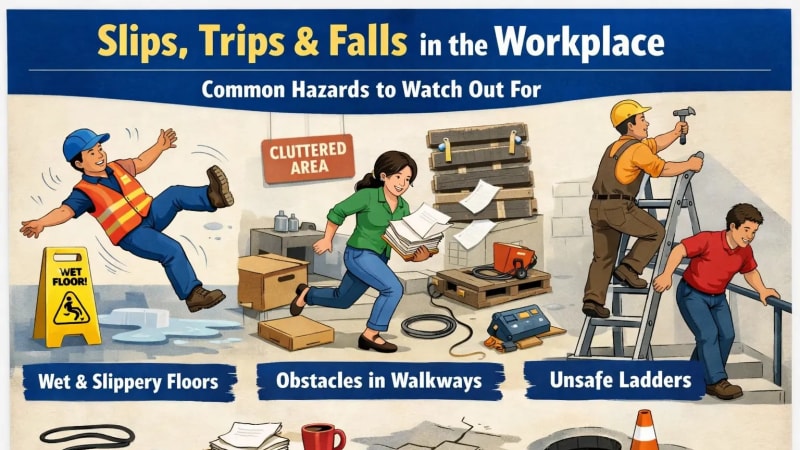
Fall Protection and Slip Prevention Training
According to OSHA, fall protection has been the single most cited safety violation for 14 consecutive years, with more than 6,300 violations recorded in the most recent annual report. This applies most heavily to construction, but general industry employers with elevated work areas face the same exposure. Training must cover fall hazards specific to the worksite, protective systems in use, and proper use of fall arrest equipment.
Bloodborne Pathogens and Healthcare-Specific Requirements
Healthcare workers, first responders, and any employee with potential exposure to blood or other infectious materials must receive annual bloodborne pathogen training under 29 CFR 1910.1030. This includes exposure control protocols, proper use of PPE, and post-exposure procedures.
Workplace Safety Training Requirements by Industry
Requirements differ significantly across industries. Here is a direct breakdown of the key mandatory training areas for four major sectors:
| Industry | Primary Standard | Key Required Training Areas |
|---|---|---|
| Construction | 29 CFR 1926 | Fall protection, scaffolding, excavation safety, electrical hazards, OSHA 10 or 30 recommended |
| Manufacturing / Warehouse | 29 CFR 1910 | Lockout/tagout, forklift operation, machine guarding, HazCom, PPE |
| Healthcare | 29 CFR 1910 + CDC | Bloodborne pathogens, ergonomics, violence prevention, respirator fit testing |
| Retail / Office | 29 CFR 1910 (general) | Emergency action plan, fire safety, ergonomics, basic HazCom if applicable |
26 states operate their own OSHA-approved state plans, including California, Washington, and Michigan. These states must meet or exceed federal standards. California's Cal/OSHA, for example, requires a written Injury and Illness Prevention Program with documented training protocols for all employers.
How Often Do Employees Need Safety Training? Frequency and Retraining Rules
This is the question most employers get wrong, and it is one of the most common reasons OSHA finds documentation gaps during inspections.
Annual Training Requirements: What Must Be Repeated Every Year
- Bloodborne pathogen training
- Forklift and powered industrial truck operation
- Hazard communication for new chemicals introduced in the workplace
- Fire extinguisher use if employees are expected to use them
- Respirator use and medical evaluation where applicable
Retraining Triggers: When Immediate Training Is Legally Required
OSHA requires retraining any time one of the following occurs:
- A workplace incident or near miss involving a trained hazard
- Introduction of new equipment, chemicals, or work processes
- An employee demonstrates through observed behavior or testing that they have not retained prior training
- Changes to OSHA standards affecting the employee's role
Three-Year and Role-Based Training Cycles
Some training, such as confined space entry and certain emergency response roles, requires recertification on a multi-year cycle. Supervisors and safety officers often have additional role-specific requirements beyond what general employees receive.
New Employee Safety Training Requirements: What Must Happen on Day One
New employees are statistically the most vulnerable to workplace injuries. OSHA requires that training happens before employees are exposed to hazards, which means day one is the legal minimum for most required topics.
First-Day Safety Briefing Requirements Under OSHA
At minimum, new employees must receive:
- A site-specific emergency action plan orientation
- Introduction to any chemical hazards they may encounter
- PPE requirements for their role
- Location of first aid kits, eyewash stations, and emergency exits
This does not need to be a full multi-day program, but it must be documented.
Role-Specific Onboarding Training: How to Build a Compliant Safety Induction
A one-size-fits-all orientation is not compliant. A warehouse associate who operates a forklift requires different training than an office worker at the same company. Map each role's hazard exposure profile first, then build training around what that specific employee will actually encounter.
What Happens If an Employer Fails to Provide Required Safety Training?
The financial consequences of skipping required training go far beyond a single fine. OSHA's updated penalty structure that took effect in January 2025 raised the stakes significantly for non-compliant employers.
2025 OSHA Penalty Amounts for Safety Training Violations
A single unannounced OSHA inspection of a 50-person facility with documentation gaps across multiple training categories can result in six-figure fines in a single day. The math compounds quickly when each untrained employee is a separate citation.
Real Cost of Non-Compliance: Fines, Claims, and Reputational Damage
Penalties are only part of the story. According to OSHA's own business case data, American employers pay more than $1 billion every week in direct workers' compensation costs alone. The Liberty Mutual 2025 Workplace Safety Index puts the cost of a single serious nonfatal workplace injury at roughly $42,000 in direct costs, before legal fees, turnover, and insurance premium increases are factored in.
The Smart Business Case for Investing in Employee Safety Training
Some employers view safety training as a cost. The data treats it as an investment with a measurable return.
According to research cited by OSHA, employers who invest in structured workplace safety programs see a return of between $4 and $6 for every single dollar spent. That figure accounts for reduced injury claims, lower absenteeism, faster productivity recovery, and fewer regulatory penalties.
How Effective Training Reduces Workers' Compensation Costs and Insurance Premiums
Insurance carriers actively review workplace safety training records when setting premiums. Companies with documented, consistent training programs in place typically qualify for experience modification rate reductions, which directly lower annual insurance costs. A well-run occupational health and safety training program is one of the few compliance investments that shows up positively in both your safety record and your balance sheet.
How to Build a Compliant Workplace Safety Training Program Step by Step
- Conduct a Workplace Hazard Assessment. Walk every area of your workplace and document the specific hazards present. OSHA requires this assessment to be written and signed by the person who conducted it. This document becomes the foundation for every training decision that follows.
- Identify Required Training by Role and Industry. Cross-reference your hazard assessment with the OSHA standards that apply to your industry and the specific job tasks of each role. Do not apply the same training list to every employee. Match the training to the exposure.
- Deliver Training in a Language Employees Understand. OSHA explicitly requires that training be provided in a language and at a literacy level that employees can understand. Providing English-only training to a Spanish-speaking workforce is a compliance failure, regardless of how thorough the content is.
- Document, Track, and Maintain Training Records. Every completed training session must be documented. Records should include the employee's name, the topic covered, the date, the trainer's name or the platform used, and the employee's acknowledgment of completion. This documentation is what OSHA inspectors ask for first.
Workplace Safety Training Documentation Requirements
What Records OSHA Requires Employers to Keep
- Employee name and job title
- Training topic and the specific OSHA standard addressed
- Date of training
- Name and qualifications of the trainer
- Method of delivery (in-person, online, written materials)
How Long Training Records Must Be Retained
Retention periods vary by standard. Here are the three key benchmarks:
When in doubt, retain longer. OSHA can request records from past inspection cycles, and gaps discovered years later can still result in citations.
FAQ: Workplace Safety Training Requirements for Employees
Build a Compliant Workplace Safety Training Program
Start with a hazard assessment, map training to each role, and document everything. The employers who treat safety training as a priority build safer teams and avoid six-figure OSHA fines.
Start Building Your Program →